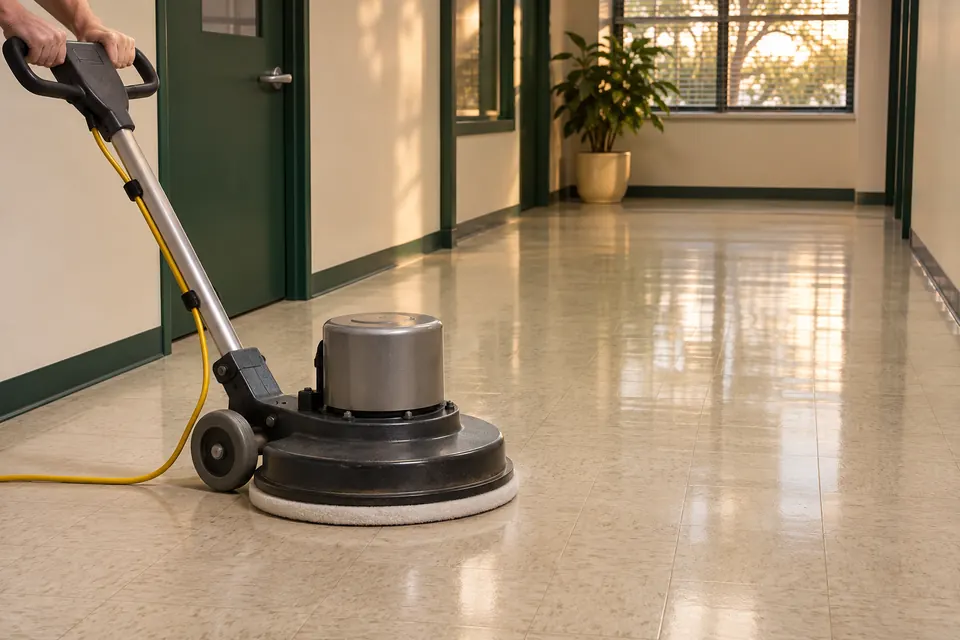
Floor stripping and waxing in Watertown, NY refers here to the care of compatible resilient flooring and its finish system. It does not mean sanding hardwood, polishing stone or coating every vinyl product. A provider needs the material, condition and operating schedule to assess a suitable process.
Confirm the flooring before choosing a finish
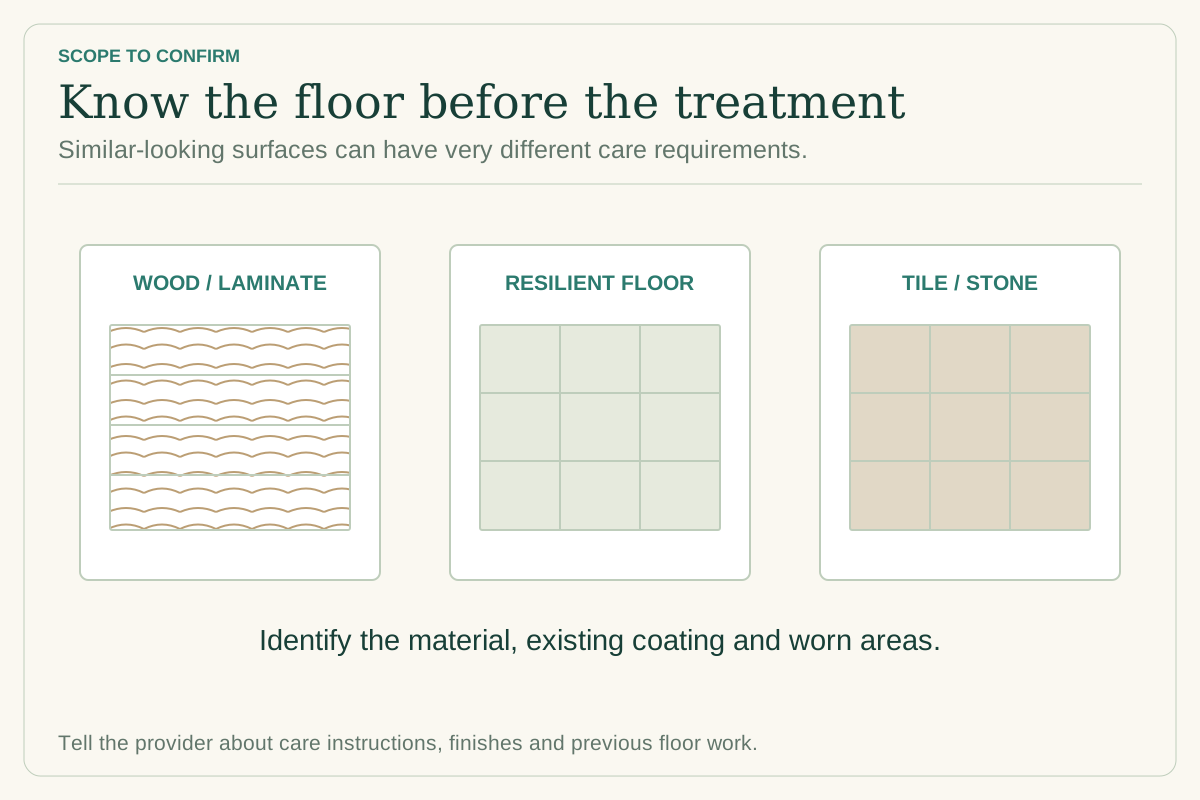
Look for the product name, installation record and manufacturer's maintenance instructions. VCT, luxury vinyl, sheet flooring and other resilient products can have different requirements. The appearance of a square tile is not enough to determine whether a coating should be applied.
Armstrong's maintenance guidance illustrates why this matters: it specifies different treatment for different products, including surfaces that should not receive polish. Ask the provider to identify the floor and finish system before recommending pads, chemicals or a maintenance schedule.
Compare the level of work needed
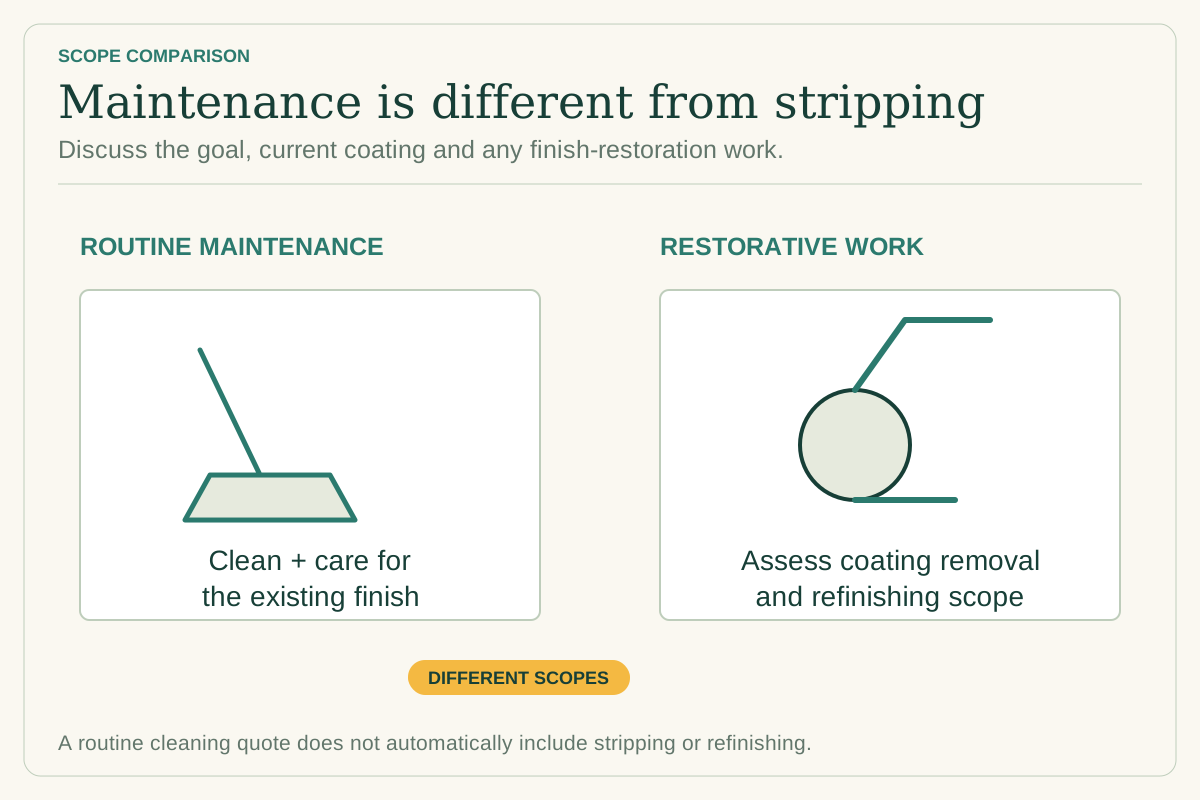
Routine cleaning removes accessible soil while preserving a suitable existing finish. A scrub and recoat may renew an appropriate finish without taking it all back. Full stripping removes the existing coating so the floor can be prepared for a new compatible system.
These are different scopes, not simply different names for the same shiny result. Ask what condition supports the recommendation and whether a trial area is appropriate. The proposal should distinguish appearance improvements from repairs to damaged tile, adhesive failure or a problem below the flooring.
| Approach | Purpose | Decision to confirm |
|---|---|---|
| Maintenance clean | Remove soil without a full finish reset | Existing finish and floor condition |
| Scrub and recoat | Renew a suitable finish system | Compatibility and preparation |
| Strip and refinish | Remove the old coating before renewal | Material, residue removal and downtime |
Plan the work area and safe access
Decide who removes desks, shelving, mats and other furnishings. A finish applied around heavy objects leaves a different result from an empty-room treatment. Tell the provider about narrow passages, fixed equipment, outlets, water access and adjoining floor types.
A workplace also needs a plan for people who use it. Agree which areas will close, how alternative routes work and who controls access during wet work and drying. Discuss safe access arrangements with the provider and building management before relying on an after-hours completion date.
Make preparation and product compatibility explicit
The written scope should address removal of old residue, cleaning, rinsing or other preparation required by the chosen system. Ask how baseboards and adjacent surfaces will be protected. More coats or a more aggressive pad do not automatically produce a better result.
If the floor has recently been installed, check the installer's and manufacturer's restrictions before wet work or equipment traffic. Share any history of peeling, powdering, sticky furniture or repeated dulling. Such symptoms may require assessment rather than another coating over the top.
Allow enough time before the building reopens
Application time is only part of the schedule. Ask about drying between stages, cure requirements, ventilation and the return of foot traffic, furniture or rolling loads. The actual floor and finish products determine the restrictions.
Do not plan on reopening solely because the surface looks dry. Confirm who decides that the area is ready and what instructions staff should follow afterward. If a business cannot close the full area, discuss whether staged work is possible and how boundaries between sections will be managed.
Build maintenance into the quote
Ask what routine cleaning and periodic upkeep the new finish will need. Specify compatible products and any pad or equipment requirements. Grit control, prompt reporting of damage and a suitable schedule can be part of the plan without assuming the floor needs full stripping on an arbitrary calendar.
When calling, provide the floor type, approximate area, furniture arrangement, current finish problems and available closure window. Ask whether the quote proposes maintenance, recoating or full stripping, and compare the reopening instructions as carefully as the price.
Questions before you call
Can all vinyl floors be waxed?
No. Different resilient flooring products have different care requirements, and some should not receive polish. Identify the product and follow its manufacturer instructions before treatment.
Does a dull floor always need stripping?
Not necessarily. Soil removal or a suitable scrub-and-recoat process may be appropriate. The provider should assess the floor and existing finish rather than recommend full removal by default.
How many coats are required?
That depends on the floor, finish system and product instructions. Ask for the proposed system and preparation. A fixed coat count without that context is not a reliable specification.
When can furniture go back?
Follow the provider's product-specific instructions for drying and cure. Foot traffic, furniture and rolling loads may have different restrictions, so build those into the reopening plan.
Useful references
Ready to describe the job?
Keep the location, scope and timing together when you call.